Marketing Agent 01 · observe · decide
See what the engines returned. Decide what deserves action.
The first preserves comparable responses and source evidence. The second normalizes the record, ranks opportunities, and hands an approved next action to the rest of the workspace.
Observation contract
Prompt · engine · region · language · source state · timestamp
Open-source starter · MIT
Try a manual baseline first with AI Visibility Probe Lite.
Before committing to a recurring scan panel, you can test how ChatGPT, Perplexity, and Gemini describe your brand using our zero-dependency open-source checklist — offline, no API keys required.
 ChatGPT
 Perplexity
 Gemini
AI Visibility Probe Lite (free, MIT)
Manual prompt runner for 10–20 buyer queries. Good for a one-off sanity check to see whether engines know your category at all.
Hermes in the Workspace (managed loop)
Automated scans of 100 to 2,000+ prompts across up to 6 engines, mention vs. citation separation, competitor Share of Answer, and direct handoff to ContentOS.
 Profound
Two layers, one record
Observation is evidence. Prioritization is a decision.
They export a mention percentage and leave your team guessing which gap is closeable, which page is missing, and who will write and publish the fix.
It stores the prompt, engine, region, language, answer state, exposed source links, and observation time without pretending the sample is the whole market.
It compares like with like, distinguishes citations from mentions, ranks closeable gaps, and hands an approved brief to ContentOS — only after a person signs off.
Three-layer visibility model
How Hermes scores visibility from 0 to 100.
Instead of hiding everything inside one opaque index, every prompt-and-engine observation is broken into three inspectable layers alongside Share of Answer against your named competitors.
| Layer | What is checked | 0 (floor) | 100 (ceiling) |
|---|---|---|---|
| 01 · Presence | Did the model name your brand in the answer to a non-branded buyer prompt? | Absent from the answer | Named in every measured run |
| 02 · Position | Where does the brand appear in the recommendation list? | Buried or only in footnotes | Top-3 recommendation with clear category fit |
| 03 · Evidence | Did the engine cite your own domain or a verifiable source backing the claim? | Unattributed mention or rival source cited | Direct link to your canonical page or proof asset |
Share of Answer: tracks what percentage of non-branded category answers name your brand compared to the exact competitor set on the same prompt panel and scan date.
What the agent returns
A traceable visibility record. Not a single magic score.
Observation
Prompt-and-engine record
The exact prompt, engine, region, language, response state, and observation time stay attached to the record.
Evidence
Mention and citation split
A mention and a citation are stored as different signals, with visible source URLs where the engine exposes them.
Context
Comparable watch set
Brand and competitor observations use the same declared scope before deltas are interpreted.
Decision
Ranked opportunity
AI Visibility Intelligence translates repeated observations into a bounded next-action recommendation.
Handoff
ContentOS-ready packet
Accepted opportunities carry prompt intent, evidence, source requirements, expected snippets, and acceptance criteria.
Follow-up
Checkpoint plan
The canonical URL, prompts, engines, regions, languages, and follow-up dates remain part of the same record.
Workspace · AI Visibility · Prompts
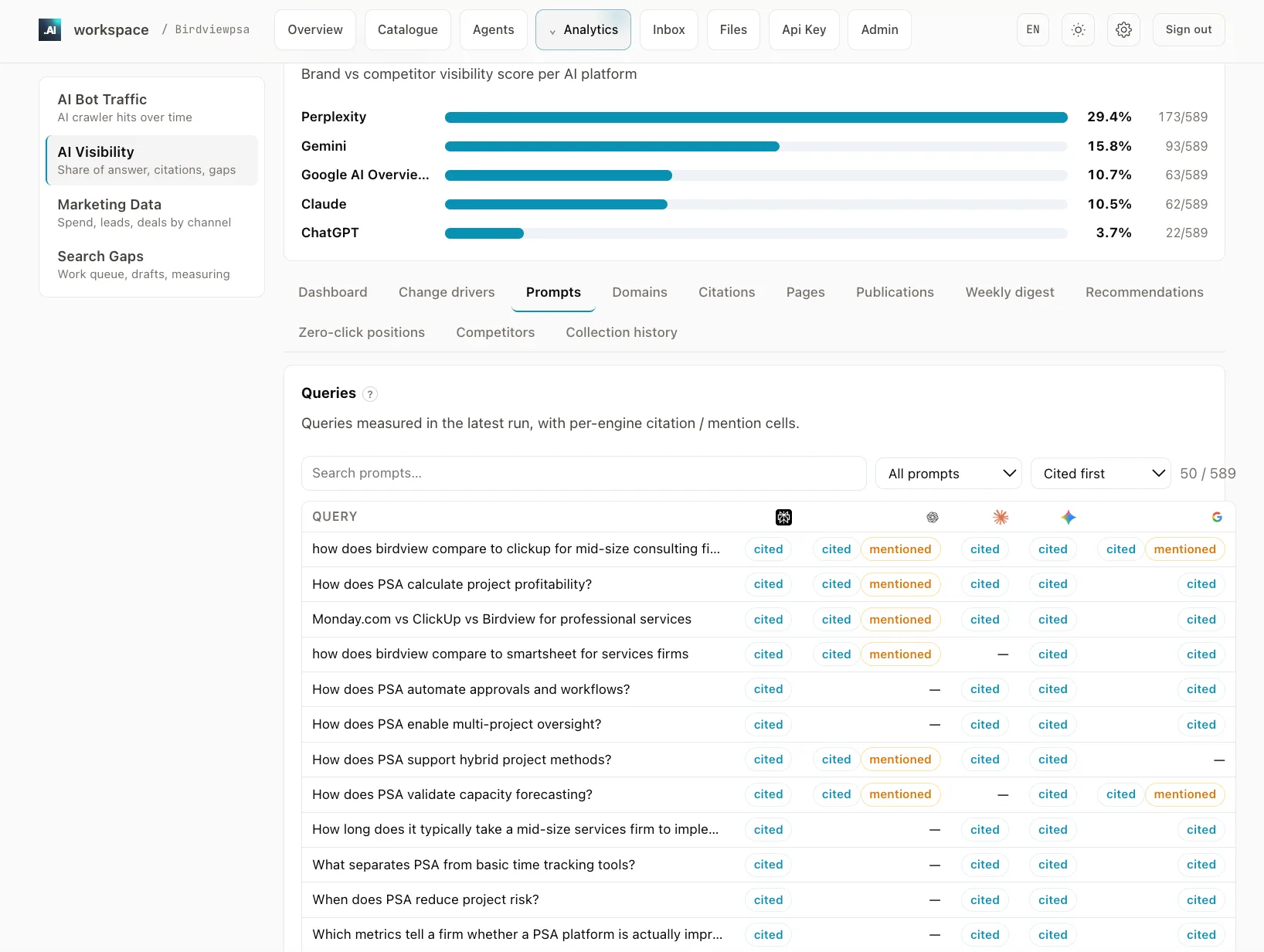
The mention/citation split is a data structure, not a footnote. Fifty of 589 tracked prompts shown. A cell reads cited when the engine exposed a source that supports the statement, and mentioned when the brand was named with no source behind it. Rows carrying both on the same engine are the interesting ones: the brand is in the answer, and something else is the evidence.
One run, five engines
The same brand is a different brand on every engine.
Workspace · AI Visibility
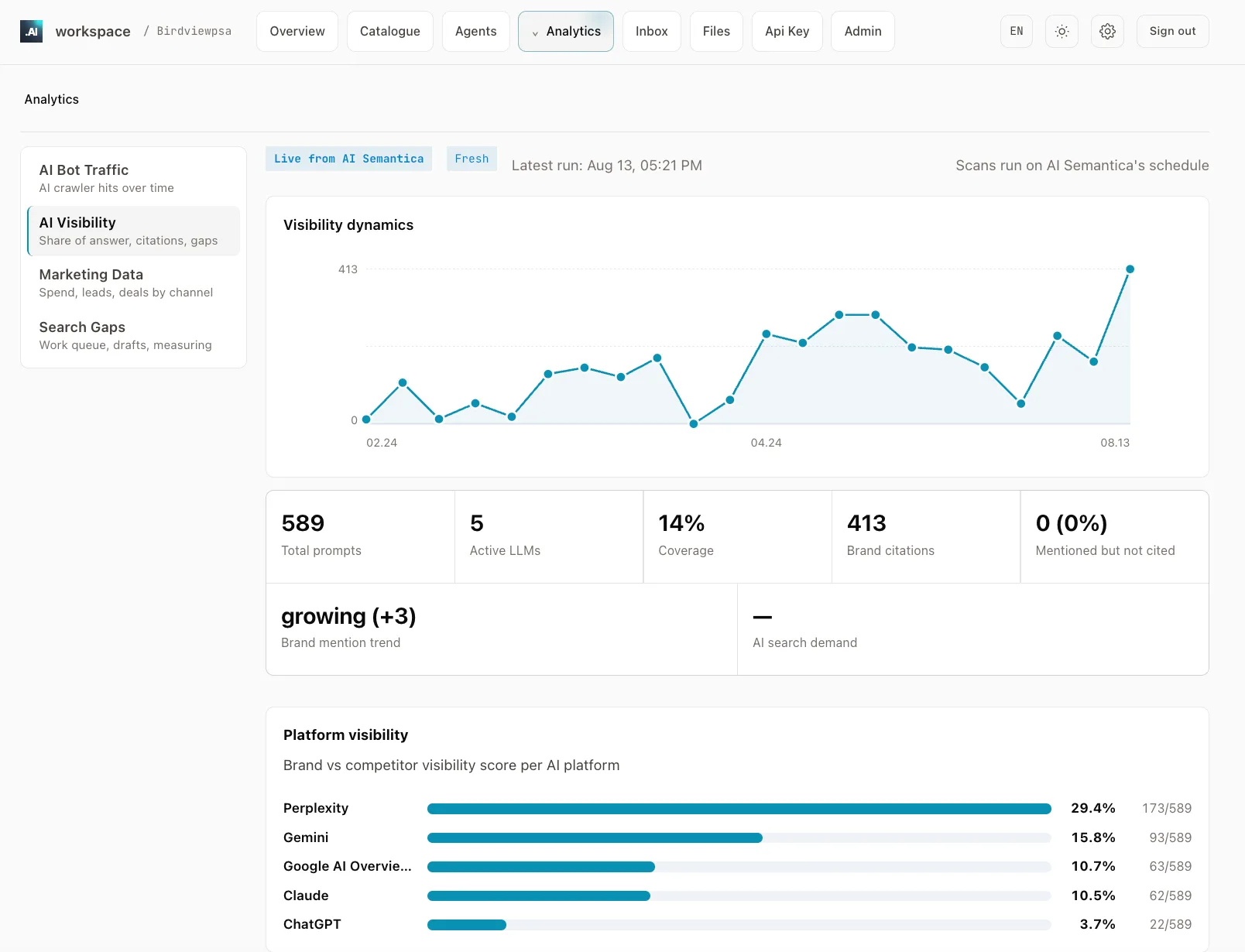
One run across 589 prompts and 5 engines. Perplexity 29.4% (173 of 589), Gemini 15.8% (93), Google AI Overviews 10.7% (63), Claude 10.5% (62), ChatGPT 3.7% (22). Coverage 14%, 413 brand citations, 0 mentioned-but-not-cited.
 Google
 Claude
Blending those five into one number would report roughly 14% and hide the only decision worth making here — that the brand has an eight-fold gap between its best and worst engine, and the work that closes it is engine-specific.
Operating loop
Measure, interpret, hand off, then measure again.
- Declare the watch set. Approve the brand, competitors, prompts, engines, regions, languages, and observation window.
- Collect bounded observations. Preserve the response state and visible source links for each query.
- Normalize the evidence. Keep mentions, citations, sentiment, and unavailable responses as separate fields.
- Approve the next action. Turn only accepted opportunities into a content, publishing, distribution, or website handoff.
- Register the canonical URL. After publication, monitor the same prompt set at declared checkpoints without claiming causality from one observation.
Not measured
An empty panel says “not measured yet.” It does not say zero.
Workspace · AI Visibility · Dashboard
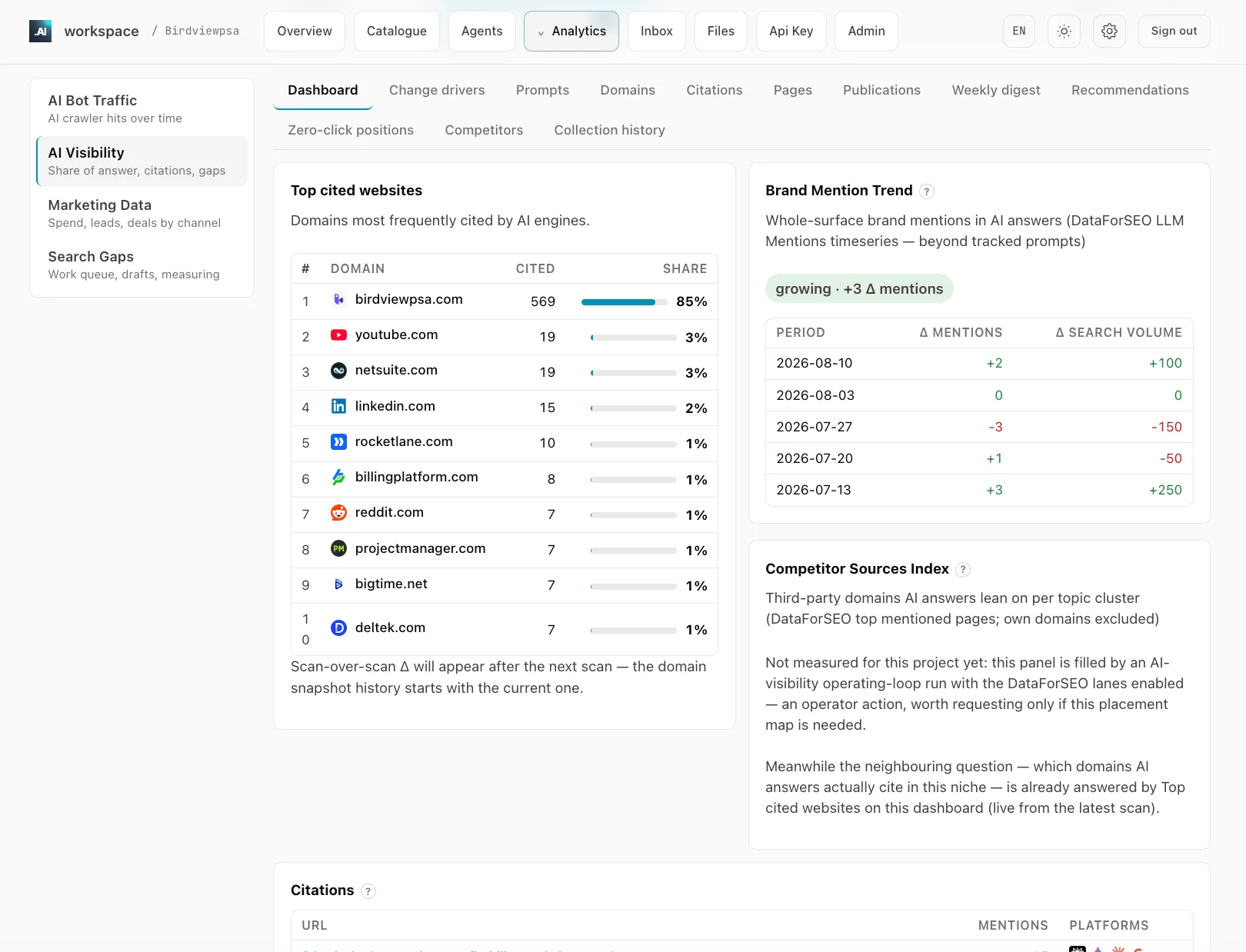
Absence of a reading is displayed as absence. The Competitor Sources Index panel carries no chart and no zero. It states that the measurement has not been run for this project, names the operator action that would fill it, and points to the neighbouring panel that already answers part of the same question from the latest scan.
This is the smallest visible piece of the loop and the one we would defend hardest. A dashboard that renders an unmeasured panel as 0% teaches its reader to act on a number nobody collected.
Why measurement first
Fixing is only possible when you measure.
“You can only fix what you measure.”
 Humanswith.ai
Why it works in practice: we measure humanswith.ai's own visibility and client benchmarks with the same Hermes across seven global answer engines, strictly separating Non-Branded Commercial Demand prompts from Branded lookups. Across October 2026 non-branded snapshots, Hermes tracked Birdview PSA (589 US prompts: 22.6% ChatGPT, 29.4% Copilot, 413 cited domain links, #1 of 12 PSA brands), Perfect Panel (277 brand-free prompts: 69.3% mention, 7.1% of answers link to the site), WEISAN (188 brand-free prompts: 58.5% mention, 14.9% link), and Raqma (591 brand-free prompts: 52.1% mention, 26.5% link). Read our 5-Turn Buyer Conversation Benchmark and verified B2B case studies.
 Birdview
 Copilot
 Perfect
 WEISAN
 Raqma
Methodological basis — Greg Shevchenko's research on workspaces for AI agents: read on gregshevchenko.com.
For founders
See where buyers already ask AI
Get a dated baseline of non-branded category prompts so budget goes to closeable gaps, not guesswork.
For marketing leads
Turn scan deltas into a weekly backlog
Replace manual spreadsheet tracking with ranked briefs that flow directly into ContentOS and Content Publisher.
For multi-market teams
Compare engines across regions and languages
Keep US, EU, 🇬🇧 UK, and regional prompt panels separate so each market sees its own citation sources and competitors.
Hermes FAQ
Measurement terms, kept honest.
What is Hermes?
Hermes is the observation layer for AI visibility. It collects prompt-and-engine responses, source links, mention state, citation state, and comparison context for an approved watch set.
What is AI Visibility Intelligence?
AI Visibility Intelligence is the decision layer nested under Hermes. It normalizes observations, separates citations from mentions, ranks opportunities, and creates governed handoffs for the next action.
Is a brand mention the same as a citation?
No. A mention says the brand appeared in an answer. A citation means the answer exposed a source that supports the statement. Hermes stores them as different signals.
What do the 0–100 score and Share of Answer measure?
The score combines three observable layers: Presence (did the brand appear in the answer), Position (was it named early or buried in a long list), and Evidence (did the engine link to your page or rely on third-party sources). Share of Answer tracks your brand’s percentage of answers relative to named competitors on the exact same prompt set.
How often does Hermes scan, and which engines does it cover?
Starter, Growth, and Scale plans scan monthly; Outlier scans twice a month. On global projects Hermes covers up to six answer engines — ChatGPT, Perplexity, Gemini, Google AI Overviews, Google AI Mode, and Microsoft Copilot — plus Claude and regional engines when scoped.
 Google
How is Hermes different from standalone trackers like Profound, Otterly, or AthenaHQ?
 Otterly
 AthenaHQ
Standalone trackers stop at dashboards and screenshots, leaving your team to decide what to write, publish, and fix. Hermes feeds directly into ContentOS, Content Publisher, and Website Agentic Optimization inside one workspace so every prioritized gap turns into a governed production packet.
Can we export raw scan data and connect alerts?
Yes. Every scan exports to CSV and a read-only dashboard link. Scale and Outlier plans also support webhook delivery into Slack, Telegram, or Twenty CRM when visibility shifts.
What does Hermes cost, and when do first results show?
Plans start at $149/month (Starter: 100 prompts) and scale to $4,977/month (Outlier: 2,000 prompts across six engines plus up to 40 articles/month), with Custom plans above that. Your baseline is ready in days; measurable citation lift after closing gaps typically appears in 5 to 9 weeks.
Start with an observable question. Not a guaranteed outcome.
We will define a comparable watch set and show what evidence the workspace can preserve before proposing any production work.